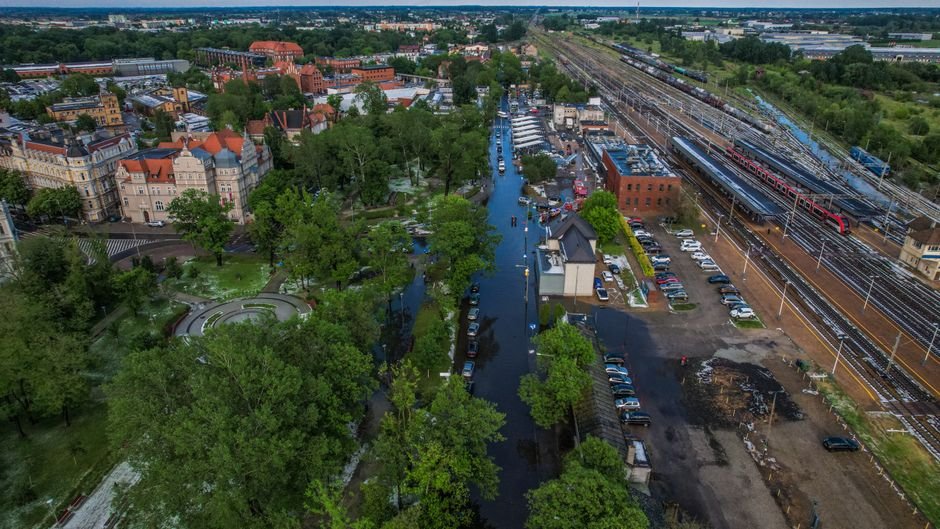
When we talk about supply chain resilience or crisis communication in boardrooms, we rarely picture a man walking in front of a heavy locomotive holding a red flag. Yet, the viral footage from Satna, Madhya Pradesh, where a railway worker literally led a train through flooded tracks, is a masterclass in risk mitigation and crisis leadership. This is a visceral example of railway safety operations being stripped down to the absolute basics when the technology we usually trust fails. In an age where we rely on automated signaling and real-time sensor data, seeing human intervention guide a massive machine through a waterlogged path is a jarring reminder that sometimes, there is no substitute for boots on the ground.
For those of us in the marketing and corporate communication world, the reflex is often to automate our way out of problems. We build elaborate tech stacks, deploy AI-driven chatbots to handle customer complaints, and lean on programmatic workflows to keep the engine of growth humming. But look at what happened in Chitrakoot. When the tracks were compromised by floods, the high-tech sensors likely triggered safety stops, stalling the train. That is where the human element stepped in. The worker did not wait for a digital update or a remote override; he became the signal. He communicated intent, managed the movement, and ensured the asset reached its destination safely despite the chaos of nature.
This incident is a direct rebuke to our obsession with ‘frictionless’ processes. We spend millions trying to eliminate human oversight, yet real-world scenarios—whether it is a logistics failure, a PR disaster, or a supply chain collapse—require someone to step out from behind the screen and hold up the red flag. When you strip away the branding and the slick automated workflows, railway safety operations effectively boil down to trust and clear, human-led guidance. If your brand communication strategy cannot handle a moment where the digital signal turns red, you are not prepared for a real crisis.
Consider how brands typically react to a sudden downturn or a social media firestorm. Most reach for the automated response, sending out pre-approved, robotic statements that sound like they were written by a motherboard. They fail to understand that like that train engine in the flood, a brand in crisis needs a human pilot. People do not connect with protocols; they connect with individuals who take responsibility and provide clear, tangible direction. That railway worker was the ‘brand ambassador’ in that moment, acting with complete clarity while the mechanical systems were rendered useless by the environment.
In the marketing industry, we are constantly fighting for efficiency. We want 24/7 engagement with zero downtime. But this incident proves that true reliability is often found in the ability to pivot to analog methods when the digital path is submerged. Perhaps we should look at our own workflows and ask: do we have a plan for when the tech breaks? Or have we become so dependent on our algorithms that we have forgotten how to manually operate the business? The railway worker didn’t just walk the track; he restored order to a paralyzed system.
This is not just about trains or floods. It is a fundamental truth about operational integrity. When the infrastructure of your market—be it your distribution network, your public image, or your internal communication chain—is flooded with challenges, you need leaders who can function in the analog space. We need to stop viewing human intervention as a failure of tech and start viewing it as the final, necessary layer of safety. We often laud the ‘smart’ city or the ‘smart’ campaign, but we should be praising the ‘resilient’ human who knows exactly what to do when the sensors fail.
Ultimately, railway safety operations under duress highlight a critical gap in modern corporate philosophy. We are so focused on scaling that we have neglected the art of simple, manual oversight. If we want our brands to survive the proverbial floods, we need to stop hiding behind our dashboards. Sometimes, you just have to step out, grab the red flag, and lead the way through the water yourself. That is not just good railroading; that is sound management. The next time your project hits a wall, don’t look for a new plugin. Look for the person who is willing to walk the track.